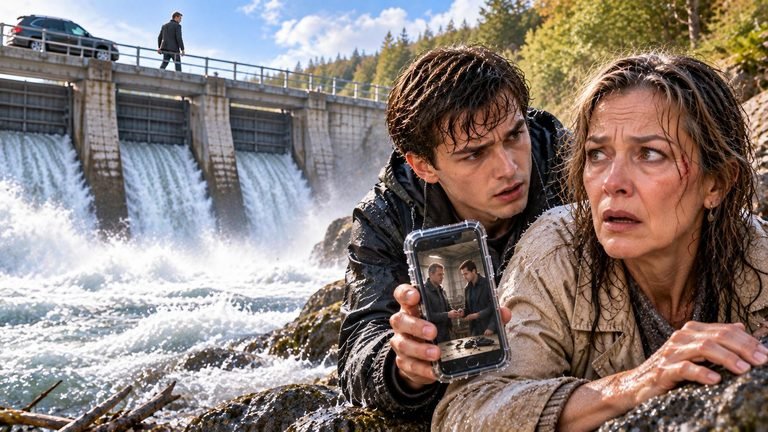
“Whatever you do, don’t let the woman by the casket see this envelope. My mom said to put it directly into your hands!”
That desperate whisper came from right behind my back, beside the fresh grave of my only son. A boy with the weary eyes of a grown man tugged at the hem of my black coat so sharply that I nearly lost my balance, as the corner of a thick envelope pressed into my palm.
My name is Eleanor Vance, and I am 60 years old. For more than 30 of those years, I poured everything into building Vance Freight Lines from scratch into a massive trucking corporation, while also establishing an estate near Richmond, Virginia. In business, I was used to speaking plainly and firmly, closing deals worth tens of millions of dollars, firing bad actors, and standing ground through any corporate audit. But when the phone rang on a cold October morning to tell me that my 32-year-old son Caleb had been killed on a rain-slicked highway, my world shattered into pieces.
A cold wind stripped the leaves from the cemetery trees. Dozens of people stood around the heavy casket: business partners, drivers, and Caleb’s childhood friends. The minister was droning through the end of the service. Against my will, all my attention was drawn to Alyssa, my son’s young widow. Two lawyers were carefully holding her by the elbows.
She played the role of the grief-stricken woman flawlessly. Every 2 minutes like clockwork, she dabbed the corners of her eyes with a lace handkerchief, her shoulders trembling delicately, yet her mascara remained intact and her hairstyle stayed immaculate. I had known my daughter-in-law for 4 years, ever since my son met her at a logistics conference. She had eased her way into our family with quiet, calculated charm. But right now, my gut was screaming that every bit of it was an act.
When the service ended, someone tugged at my sleeve again. Looking down, I saw a child of about 9. Thin, wearing a dark navy jacket with frayed, mended cuffs. Most striking of all, his determined jawline and gaze looked identical to Caleb back in the 3rd grade.
The boy glanced back at Alyssa, who was receiving condolences, and whispered hurriedly:
“Take it quickly and hide it in your pocket. Mom told me to give it only to you. And make sure that woman doesn’t see.”
I shielded him from the crowd with my back:
“What’s your name?”
“Timothy,” he answered with an unchildlike composure.
The boy slipped the heavy, warm package into my pocket and quickly vanished among the granite headstones. I didn’t even have time to call after him.
The wake passed by in a blur. By 21:00, everyone had cleared out. Alyssa, blaming a migraine, called a cab into town. The estate manager, Samuel, bolted the doors and retired to the guest lodge.
At 23:00, I locked myself in my study and cut open the envelope. A heavy key stamped with the number 48 hit the desk with a sharp clatter. I recognized it immediately: it belonged to the storage lockers at our old distribution terminal in Oakwood.
Next came a photograph. In it, Caleb was smiling up at me—around 22 years old, open-faced and carefree. The second document was a certified birth certificate copy for a boy named Timothy. The mother was listed as Helen Brooks, while the box for the father held a solid black dash.
Beneath that lay 4 handwritten sheets of paper:
“Dear Mrs. Vance. Timothy is Caleb’s biological son. Your grandson. We parted ways long before Alyssa, and I found out I was pregnant only after we had separated. I didn’t want to derail Caleb’s career, so I raised our son on my own. That was my mistake. I am writing to you because our boy is in mortal danger. 2 weeks ago, someone tried to run me off the road: a heavy rig rammed my car into a ditch. The police dismissed it as an accident due to bad weather, but these people are after Caleb’s papers. A month before he died, we ran into each other at a hotel, and in his rush, he left behind a briefcase full of documents. Soon after, strangers showed up at my work, openly dropping Alyssa’s name. I locked the briefcase away in locker number 48 at the Oakwood depot. The key is in the envelope. I beg of you, protect Timothy.”
Grief and the sickening realization that Caleb’s death was no accident pierced straight through me. I walked up to the 2nd floor: the boy was asleep in the guest room, curled into a tight ball. My son’s features were unmistakable in him.
Just after 00:00, I dialed my corporate attorney, Ingrid Hayes:
“Come over right away. I need access to a private genetic testing lab.”
40 minutes later, Ingrid was sitting across from me:
“3 years ago, while setting up a $1,500,000 life insurance policy, Caleb underwent extensive medical screenings. His biological samples are stored in a cryobank at an authorized medical facility in Washington, D.C. I will secure authorization to retrieve the samples for testing. The DNA results will take 48 hours, but the court process will take about 10 days. Until there’s a legal ruling, the boy is completely unprotected.”
At that moment, Samuel knocked softly on the study door:
“Mrs. Vance, take a look through the living room window. Keep the lights off, please.”
150 yards from the gate, under the shadows of the elms, sat a dark SUV with its headlights off. The license plates were caked in mud. The vehicle was staking out the exit.
“Samuel, move the boy to the bedroom facing the inner courtyard,” I ordered.
The next morning at 08:00, Marcus Miller, a private investigator and former detective, came to pick me up. We headed to the city trauma hospital.
In room number 214 lay a frail woman with her arm in a cast and a deep bruise on her temple.
“Timothy is with me. He’s safe,” I told Helen right away.
She burst into tears of relief and confirmed:
“Caleb was completely worn down. He said people were planning a hostile corporate takeover behind his back. When he left that bag behind, Alyssa’s men showed up 2 days later. I barely had time to stash the records in Oakwood.”
At 23:00, Marcus and I arrived at the closed depot in Oakwood. We slipped inside through the dispatch office. In the quiet of the damp building, the key turned in the lock of storage locker number 48. Inside lay Caleb’s leather bag, filled with notepads, a flash drive, and corporate reports.
Lowering my flashlight, I spotted a torn slip of paper beneath the shelf. It was an old shipping invoice listing Meridian Capital as the payer.
“Alyssa used to work there before she met Caleb,” I recalled.
“Meridian Capital is a notorious corporate raiding outfit,” Marcus confirmed grimly. “She was planted in your family from day one.”
I pulled my son’s bag close against my chest. Caleb’s death had been cold-blooded murder, and I swore to see this investigation through to the very end.
By 07:00, Marcus and I returned to the estate. I locked Caleb’s bag and the Meridian Capital invoice securely in the safe. At 08:00, Ingrid Hayes arrived with a technician from the specialized genetic testing facility. Collecting the sample from Timothy took only a couple of minutes, and the technician immediately departed for the station with a courier bound for Washington, D.C., where my son’s reference samples were kept in the cryobank.
Right after, Marcus Miller entered the study carrying a thick binder containing an independent forensic auto inspection:
“Read from the second page, Mrs. Vance. This was no accident.”
The forensic findings cut straight to the bone: on the right-circuit brake hose of Caleb’s SUV, there was a concealed circumferential score mark made with a specialized cutting tool. Under intense hydraulic pressure at high speed, the line had simply burst.
“Who worked on the vehicle?” I asked quietly.
“3 days before the crash, head mechanic Gordon inspected the SUV in service bay number 4,” Marcus said, laying out surveillance stills on the desk. “He spent 35 minutes under the undercarriage instead of 5. And 2 weeks before that, a $30,000 cash deposit landed in his bank account. The night before the tragedy, he placed 4 calls to a burner phone pinging within the same city block as our corporate headquarters. The traitor is inside executive leadership.”
An hour later, the call came in from the lab: the biological relationship between Timothy and Caleb was confirmed at 99.9%. The direct legal heir to a share worth millions of dollars had been officially established.
“We can’t keep the boy here; the estate is under surveillance,” I decided.
Samuel brought around an old gray Ford pickup truck used for hauling hay. Timothy pulled on his winter coat and climbed into the back behind a plywood partition.
“You’re heading to my sister’s place near Raleigh, North Carolina, into a secure gated community under private guard,” I instructed my grandson.
“Will you be all right, Mrs. Vance?” the boy asked anxiously.
“I’ve been in this business for 30 years, and much tougher people than them have broken their teeth trying to take me down,” I smiled, gently stroking his head.
The truck slipped out through the back gates, taking a winding dirt road through the woods to bypass the stakeout.
At 14:30, Alyssa’s silver Mercedes crunched along the driveway up to the porch. I had prepared for her visit: I draped a shapeless gray shawl over my shoulders, tousled my hair, wiped off all my makeup, and took on the appearance of a bewildered, grief-stricken old woman.
Alyssa walked in with total confidence, holding a container of chicken broth:
“Mrs. Vance, you look completely drained! You shouldn’t be left alone to shoulder such a massive empire. Maybe it’s time to sell the company to a major investment firm and just enjoy your peace?”
“I just don’t have any strength left, sweetheart,” I lamented, staring blankly down at the desk. “I told Victor Ross over in finance to handle it however he sees fit—let him plug the holes and figure out where to offload the assets.”
“And who was that boy who approached you at the cemetery?” my daughter-in-law asked casually.
“Just the grandson of Pete the mechanic—he was begging for cash to help cover his grandfather’s funeral expenses. I tossed him some loose change and sent him on his way,” I replied, waving my hand dismissively.
Alyssa breathed a quiet sigh of relief, planted a light kiss on my cheek, and hurried back toward the city.
The second her car was out of sight, I cast off the shawl and gathered my core team. We needed ironclad proof against the top players behind this conspiracy. We drafted a dummy file coded North-74—supposedly an idle, mothballed logistics terminal at the Fairfax Depot valued at $9,500,000, which was supposedly being liquidated for pennies on the dollar due to mounting debt. We embedded an invisible digital tracker right inside the document. The file was then placed into a restricted network folder.
The following morning at the office, I played completely broken and indifferent in front of our Chief Financial Officer, Victor Ross, leaving the North-74 decision entirely in his hands. He could barely mask the predatory gleam in his eyes.
The trap snapped shut that very evening. At 17:20, Victor downloaded the file onto an encrypted flash drive, and 2 hours later, while sitting at a restaurant, he forwarded it directly to Anthony Rhodes at Vanguard Equities. By 20:00, Rhodesformally contacted Ingrid Hayes, offering to acquire the nonexistent terminal for $2,000,000 in cash. Pure greed had blinded the raiders completely.
By morning, a comprehensive dossier documenting premeditated murder and corporate fraud was sitting on the desk of an FBI Special Agent. The mechanic, Gordon, was apprehended right inside service bay, and he began talking immediately. Our CFO, Victor, was intercepted in the underground parking garage holding a briefcase packed with foreign passports and $300,000 in cash.
At 11:30, Alyssa breezed into my office wearing an emerald-green coat:
“Caleb took out a $1,500,000 life insurance policy naming me as the sole beneficiary. Add to that my legal widow’s share. Sign over the asset transfer to Vanguard Equities, and don’t make your own life difficult.”
“And you genuinely believed you had calculated every single angle,” I replied coldly, staring right into her eyes. “Just how much did Rhodes promise you for Caleb?”
The door swung open, and federal agents entered alongside the lead investigator:
“Ms. Sterling, you are under arrest for conspiracy to commit murder-for-hire in the death of your husband.”
“You can’t prove anything!” Alyssa shrieked, but the handcuffs were already clicking shut around her wrists.
“Victor and Gordon have already proven everything, sweetheart,” I remarked with a dry smile.
2 weeks later, based on the DNA analysis, the Virginia Circuit Court officially recognized Timothy as Caleb’s legitimate son and the sole legal heir to his estate. Helen was discharged from the hospital, and I brought her back to our estate to recover.
On Saturday, I personally drove to bring Timothy home from Raleigh, North Carolina.
Today at 06:00, we walked out to the stables. The crisp air was crystal clear, and steam rose quietly above the paddock. Timothy gazed in fascination at the black stallion.
“Mrs. Vance, did Dad really love these horses?” he asked, turning his dimpled face toward me.
“He grew up right here,” I replied, placing a hand on his shoulder. “And all of this belongs to you now.”
The boy placed his warm hand over mine:
“We can do this, Grandma. I’ll help.”
Justice always claims what is due, no matter how much evil stands in its path.
What would you have done in Mrs. Vance’s place, learning about the existence of a grandson right at a cemetery, and which trait helped her outsmart such dangerous enemies?