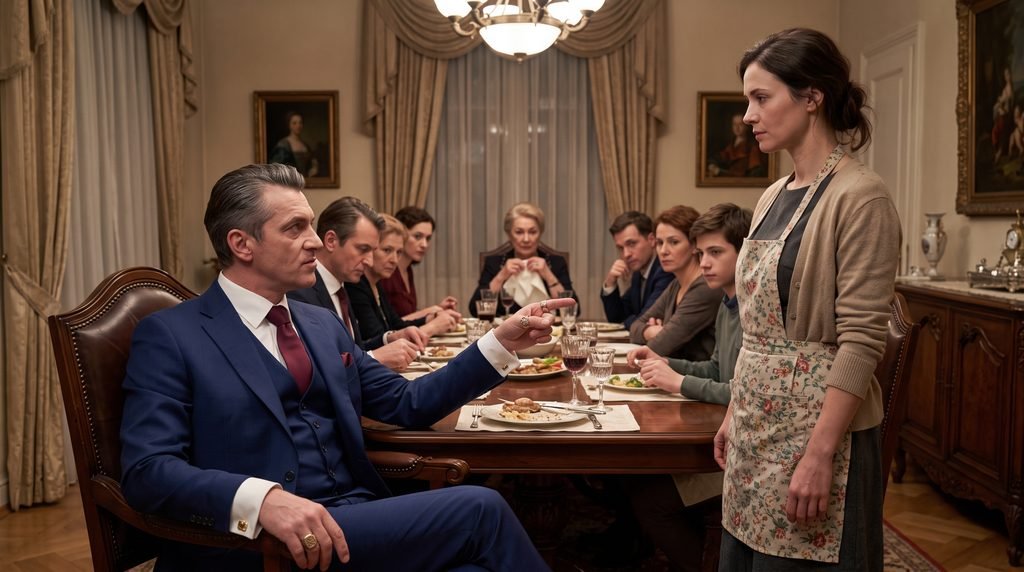
If you think your future in-law can humiliate you right on your doorstep without facing consequences, just wait until Monday.
My name is Dr. Eleanor Davis. I am 51 years old, and I have dedicated nearly 30 of them to medicine. My work demands nerves of steel and quiet focus. When you spend hours holding human life in your hands, any urge to show off titles and awards simply disappears. At home, I have always remained just a mom. My 26-year-old daughter, Chloe, grew up accustomed to me disappearing on long hospital shifts and keeping my work life completely separate from our family. To her, I was just an ordinary doctor.
I live in the suburbs, in a simple brick house with an apple orchard. That Saturday, I put on a beige cardigan, tied on an apron, and spent the entire morning bustling around the kitchen: roasting meat, baking a pie. The occasion was an important one—Chloe was introducing me to the parents of her fiancé, Austin. They had been dating for about 1 year, and things were heading toward a wedding.
At precisely 14:00, a gleaming luxury SUV pulled up to our gate. The first to step out was the groom’s father, Mr. Gregory Vance—a 54-year-old man wearing a flashily expensive sport coat and a heavy gold watch. Next fluttered out his wife, Mrs. Veronica Vance, wearing a silk scarf and scanning the gravel driveway with a look of utter distaste. Following them were Austin, a physician at a private clinic, and his 22-year-old brother, Dylan, carrying a bouquet of white roses.
Chloe greeted them with a smile, but anxiety flickered in her eyes. I stepped out onto the porch:
“Welcome, please come on in!”
Mr. Gregory Vance gave my hand a limp shake, squinting critically at our window frames and old apple trees:
“So this is where you reside. Fresh air, peace and quiet… A romantic setting for people tired of life. Austin mentioned you’re a doctor. I get it. The public sector is an endless sacrifice for pennies. Prices keep climbing, retirement is right around the corner, and the government couldn’t care less.”
“Hello, Dr. Eleanor Davis,” Mrs. Veronica Vance added, pursing her lips in disdain. “The roads out here are awful; we could barely find the turnoff. Keeping up a property like this on a single doctor’s salary must be an enormous chore. Do you weed the garden yourself?”
“I do,” I answered evenly. “Physical labor clears the mind after long shifts.”
Dylan looked embarrassed, took a step forward, and offered the flowers:
“Hello! These are for you. Chloe mentioned you love white roses. You have a very cozy home!”
“Thank you, Dylan,” I replied with sincere appreciation.
Austin, however, walked up with the posture of a man doing us a favor:
“Hello. Dad barely managed to squeeze out 2 hours between meetings; the clinics require constant supervision.”
“Think nothing of it, family comes first,” the prospective in-law remarked condescendingly. “We are very broad-minded people. If the bride comes from a background without influence or capital, that’s no problem at all. We are wealthy; we will help out and take in these ordinary folks. The main thing is that Chloe remembers what kind of elite social circle she is stepping into.”
Chloe lowered her gaze. I held back a smile and invited everyone inside.
In the dining room stood an oak table laden with roast meat and fresh pie. Mr. Gregory Vance made a show of taking off his watch, placing it beside his plate, and picking up his fork:
“Well now, simple home cooking. We’ve grown quite unaccustomed to this: our nutritionist watches our calories, our personal chef prepares everything steamed. But when visiting ordinary people, it’s bad manners to turn down a meal. One must stay in touch with regular folks.”
“Cutting back the budget is commendable,” his wife chimed in, picking selectively at a slice of tomato.
The groom’s father leaned back in his chair:
“Public healthcare is a dead end for underachievers. Paltry salaries, endless lines. The real money is in the private sector! Across my network of clinics, 1 dermal filler injection brings in more revenue than a public surgeon earns in a couple of night shifts.”
“Dad, public hospitals save human lives; what does cosmetic work have to do with that?” Dylan quietly objected.
“Quiet down, college student! Life is measured by profit. Austin understood where the money was right from the start.”
The man turned toward me:
“You know, Dr. Eleanor Davis, you folks could really benefit from adopting our marketing strategies. We perform deep arterial palpation using MRI machines, and for elevated blood pressure, we prescribe liver enzyme blockers at the molecular level. Have you ever heard of such methods?”
I nearly laughed out loud. He had conflated manual palpation with computed tomography and linked liver enzymes to hypertension. Any sophomore med student would have died of embarrassment. A businessman holding a medical degree was simply throwing jargon at clients.
“That is a very bold theory,” I replied evenly.
Lunch came to an end, and Mrs. Veronica Vance cut straight to the chase:
“It is time to discuss finances. The upcoming expenses will be substantial.”
“We were thinking of gathering close family in the countryside…” Chloe began.
“Oh, spare us the fairy tales!” the mother-in-law interrupted. “In our social circle, we cannot afford to lose face. Gregoryhas business partners, investors. But why burden Dr. Eleanor Davis? Where would an aging doctor get the money for a banquet venue? Why take out massive loans? Here is my proposal: the kids have a quiet civil ceremony at city hall, we gift them a vacation trip, and in the evening we celebrate at our estate. That way, no one has to drain their final burial savings.”
“Your mother is right!” the father-in-law supported. “The young couple needs a place to live. You, Dr. Eleanor Davis, cannot provide anything beyond this modest house. And Austin needs prestige. We have our eye on a 3-bedroom apartment downtown. The down payment and mortgage will be on me. So, Austin, there is no foundation from their side; you will live by our rules.”
Chloe turned pale with humiliation. Dylan tried to smooth over the awkwardness by praising my pie, while I cut him a slice and looked calmly at the mother-in-law:
“I am touched by your concern, Mrs. Veronica Vance. But the wedding will be exactly as my daughter dreamed. 3 weeks ago, we reserved the main hall at The Forest Ridge Club. The rental, live floral decor, emcee, live band, and a full menu for 60 guests are already completely paid for.”
The father-in-law froze, dropping his toothpick. The Forest Ridge Club was the most exclusive club in the area, requiring 100% upfront payment.
“Well, look at that ambition…” Mrs. Veronica Vance recovered with a venomous smirk. “How many years did you save, or what kind of loan did you take out just to throw dust in people’s eyes? We will look upon this with pity, but if you have nowhere else to throw your pension, that is your choice.”
Austin remained silent, averting his eyes. Soon the guests rose, getting ready to leave. Dylan led his mother into the living room, while the father-in-law and Austin stepped out into the kitchen.
I went into the cool pantry adjacent to the kitchen to fetch the fine china tea set. Behind the half-drawn curtain, I was completely hidden from view, but I could hear everything. The father-in-law turned on the water and hissed:
“Do you realize what you have gotten yourself into? What venue, paid with what funds?! She wiped out her burial savings! There is nothing behind this family—no connections, no capital. A penniless elderly public-sector employee living on small change and a speech therapist daughter. 10 years will pass, the mother will be bedridden on her pension, and you will carry this dead weight on your back for 30 years! A man needs to move up, not anchor himself to poverty!”
Austin stayed silent for a few seconds, then replied casually:
“I know, Dad. You’re right. I can see for myself that I rushed into this. Once we get married, I will set firm boundaries right away: not a single cent from the family budget will go to her relatives.”
At that very moment, Chloe froze in the kitchen doorway with plates in her hands. She had heard every single word. She did not drop the dishes, nor did she cry—she simply stood there, pale as chalk, looking at the traitor.
Austin turned around, saw her, and lost all color in his face:
“Chlo?.. We were just… going to help wash the dishes…”
Chloe pierced him with an icy glare, silently set the plates down on the living room table, and walked out into the hallway.
Flustered, the father-in-law shouted for his wife to get ready. The guests hurried out of the house. The SUV doors slammed shut, and the vehicle vanished around the bend.
After the guests departed, a heavy silence settled over the house. I returned to the kitchen, turned on the faucet, and began methodically washing the dishes. 10 minutes later, Chloe walked in. There were no tears in her eyes, only a frozen chill.
“Mom,” she called out softly.
“I heard everything, sweetheart. I was in the pantry,” I answered, drying my hands with a towel.
“And I saw you through the curtain. You know, the scariest part isn’t even what his father said. What’s terrifying is how easily Austin betrayed me in 3 seconds. The man who swore he loved me turned out to be a cowardly opportunist.”
“What have you decided?”
“I decided everything right there, on the kitchen threshold. But I want to look him in the eye in broad daylight. Tomorrow I’m meeting him downtown.”
“Hear him out, but don’t let him play you for a fool,” I wrapped my arms around her shoulders. “You deserve a real man, not an empty shell.”
On Sunday at 12:00, they met along a pathway in the city park. Austin walked up holding a paper coffee cup with his practiced smile:
“Hey, Chlo! Sorry yesterday turned out so awkward. Dad was just worn out from opening the new branch. You’re not still mad, are you?”
“Sit down, Austin,” Chloe cut him off. “I was standing right in the kitchen doorway and heard every single word. Including how you agreed that I’m dead weight, and that my mom is a penniless burden.”
Austin turned pale, his smug confidence vanishing in an instant:
“Chloe, you misunderstood everything! Dad is a tyrant; you can’t challenge him directly, or he’ll cut off my funding! I was just playing along for the sake of our future!”
“For the sake of a cushy chair in his clinic,” she countered with contempt. “You fear your father more than you fear losing me.”
“Don’t be stupid!” the guy snapped. “Throwing everything away over nothing? We’re getting married in 2 months, and my dad is buying us a 3-bedroom apartment downtown! Do you even realize what kind of match you’re throwing away?!”
Chloe silently took the gold cubic zirconia engagement ring from her pocket and pressed it into his palm:
“My mother paid for the venue out of her own personal funds. And I’m returning the match to you. Go live with your dad and his handouts. I will only marry a man of honor. Goodbye.”
She turned around and walked away.
“Fine, go run back to your broke mother! You’ll come crawling back on your knees!” he shouted after her, but Chloedidn’t even glance back.
On Monday at 7:30 in the morning, I pulled into the executive parking lot of the Department of Health headquarters in the city center. I took the elevator to the 4th floor to my office, took off my travel clothes, and slipped into a tailored navy wool suit of an austere, academic cut. On the lapel, as always, gleamed the gold Distinguished Physician badge and the highest state medal for contributions to transplant surgery. Standing before the mirror was not a gardener in an apron, but the Chairperson of the State Medical Licensing and Accreditation Board.
At that exact moment down on the 2nd floor, Mr. Gregory Vance was pacing nervously in a three-piece suit of English wool. Beside him scurried his corporate attorney and chief financial officer. Today, Vance Medical Group was applying for a Tier 1 General Surgical License for emergency surgery, which would open access to federal healthcare grants and government contracts worth tens of millions of dollars.
“Put the profit charts on slide 1!” Vance ordered imperiously. “We run the finest facility in the region; the board has no choice but to approve everything unanimously!”
At 9:00, around 200 professors, department chairs, and hospital directors gathered in the auditorium. Vance took a seat in the 1st row with casual confidence, setting an oversized gold-plated fountain pen on the desk in front of him.
The executive secretary announced into the microphone:
“This session of the board is now officially open. Presiding over the committee: Doctor of Medicine, Professor Dr. Eleanor Davis.”
The side door swung open, and I stepped into the hall carrying a case file. The presiding members rose to their feet in unison as a mark of respect. I took the center chair:
“Good morning, colleagues. Let us begin our session.”
From the 1st row came a dull clatter: Vance’s gold-plated pen slipped from his fingers and rolled under the seats. My future in-law froze with his mouth hanging open. The color drained from his face in a split second, leaving him paler than his dress shirt collar. Sitting before him at the head of the highest governing authority was that very same “penniless aging public-sector employee,” whose house he had so arrogantly dismissed as a shack just two days ago, and whose 30 years of medical practice he had branded a life for losers.
I locked eyes with his glassy stare and stated evenly:
“First item on the agenda: the petition from Vance Medical Group. Presenting on behalf of the applicant: Chief Executive Officer Mr. Gregory Vance. Please take the podium.”
On stiff, unsteady legs, Vance trudged toward the podium. Instead of the allotted 10 minutes, he mumbled incoherently for 7 minutes, drenched in a cold sweat. When he fell silent, I clicked on the microphone:
“Thank you for your report. Profitability is the concern of the tax authorities; our sole mandate is patient safety. I have 3 questions regarding the documentation you submitted.”
Vance gripped the edges of the podium with whitened fingers:
“Yes, Dr. Eleanor Davis… I am listening.”
“Question 1. In Appendix 4, you declare a cardiothoracic surgical unit. Yet an institutional-grade cardiopulmonary bypass machine is missing entirely. Instead, you have listed a mobile alternative that has reached the end of its operational lifespan, decommissioned 6 months ago from a neighboring state. How do you intend to save a patient experiencing an aortic rupture?”
“We planned to acquire additional equipment via leasing in the 2nd quarter…” my prospective in-law stammered amidst the disapproving murmur of the hall.
“By the 2nd quarter, dozens of people will die under your care. Question 2. Staffing. Complex open surgeries require around-the-clock duty of 2 board-certified resuscitation teams, each with at least 7 years of clinical experience. Your schedule lists only 4 anesthesiologists: 2 part-timers working half-shifts, and 2 fresh graduates without critical intubation experience.”
Vance swayed, dark red blotches spreading across his face.
“And question 3,” I continued. “Sterilization and infection control. According to records, your disposal costs for regulated medical waste dropped almost by a factor of 3 over 1 year, despite a 40% surge in your patient volume. Are you violating sanitation protocols, or are you reusing single-use disposables to chase excessive profits?”
An icy silence settled over the room. The board members looked at Vance with open disdain.
“Colleagues, we are looking at gross violations of professional standards and penny-pinching on human lives. My proposal: deny Vance Medical Group the issuance of a Tier 1 General License. Forward the evidence to the state regulatory department for an unscheduled investigation, with a concurrent suspension of their current surgical operations. All in favor?”
7 hands of the presiding board shot up in unanimous agreement.
“The motion is carried. You may take your seat, Mr. Gregory Vance.”
Vance, stooped and dragging his feet, shuffled back to his place, utterly crushed by his own arrogance.
2 days later, an unpostmarked envelope marked “Personal and Confidential” was delivered to my office. Inside lay a letter, written in Vance’s trembling handwriting:
“Dear Dr. Eleanor Davis. I am writing this not to seek a reversal of your ruling—you were right about everything. We did not earn that license. I cannot convey the humiliation I felt standing at that podium, but what haunts me even more is the shame over Saturday. My entire life, I measured people by money and luxury cars, failing to realize I had turned into a blind snob. I insulted a mother who welcomed my family to her table. But the most unforgivable part was what I said about Chloe. I raised my own son to be a spineless opportunist and convinced him that your family was dead weight. Only after losing everything in 1 instant did I realize: the real dead weight was my son, while Chloe is a person of rare soul whom we were unworthy to welcome into our home. I am closing the new branch, taking a hiatus, and committing myself to overhauling the clinics, starting with my own conscience. Please forgive me if you can.”
I placed the letter into my desk drawer. That evening, I returned to my suburban home, slipped into a sweater, and stepped out onto the porch holding a cup of tea. Soon, a cab pulled up and Chloe arrived with fresh pastries—composed and looking rejuvenated. While I poured the tea, my daughter stepped into my home office to set down her handbag.
A minute later, complete silence fell over the house. I glanced into the room: Chloe was standing in the middle of the office, holding the velvet box containing the gold medal of honor, while monographs on transplantology bearing my surname and state department binders lay across the desk.
“Mom…” she whispered in awe. “Professor, MD, head of the licensing board?.. Why did you never tell me?”
“Because at home, I am simply your mother. If you bring that kind of status into family life, it is too easy to turn into someone like Mr. Gregory Vance.”
“And my prospective father-in-law sat right at our table, lecturing you on medicine while you silently served him roast meat… Did you know how this would end all along?”
“I did,” I smiled. “There is no point in arguing with someone else’s ignorance. It is enough to do your work with integrity, and life will naturally put everything in its proper place.”
We walked out onto the veranda and embraced tightly under the rustling leaves of the apple orchard.
What would you have done in Dr. Eleanor Davis’s place: confronted the arrogant in-law right at the dining table, or kept your composure and let life teach him a lesson on its own?